
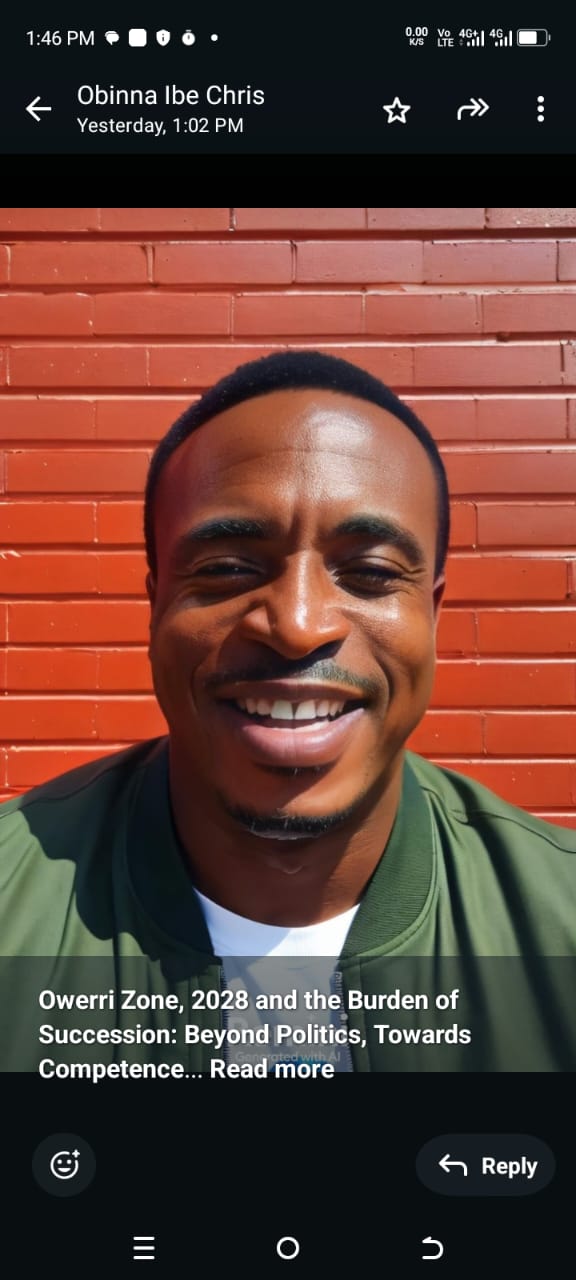
Owerri Zone, 2028 and the Burden of Succession: Beyond Politics, Towards Competence
By Dr. Obinna Ibe
Center for culture and Grassroots Development FCT Abuja
Following the Charter of Equity agreed by the Imo Elders Council and formally approved by the Governor, leaders and stakeholders from the Owerri Zone convened on 15th February 2026 to begin articulating a strategy for producing the next Governor of Imo State in 2028.
The meeting marks a critical moment in Imo’s political evolution—not merely as a rotational expectation, but as a test of political maturity, vision, and responsibility.
Yet, producing a governor is not the same as producing a leader.
As the state prepares for life after Hope Uzodimma, the conversation must move beyond zoning arithmetic, political entitlement, and sentimental claims of turn-taking. Imo State is no longer in a phase where leadership can be reduced to political calculations alone. The next governor must not only emerge from the equity framework but must also embody competence, vision, and professional capacity.
Governor Uzodimma inherited a State burdened by dilapidated infrastructure, weak institutions, insecurity, and economic stagnation.
His administration has pursued stabilisation, infrastructure renewal, energy security, and economic repositioning. These are not cosmetic achievements; they are structural foundations. Replacing such leadership, requires more than political dexterity—it requires developmental intelligence.
Imo does not need just a politician who can “do politics”. Imo needs a leader who can give patriotic, purposeful and visionary governance.
The next governor must possess: Professional aptitude, not just political experience, Economic and industrial vision, not just electoral strategy.
Institutional thinking, not factional loyalty.
Developmental competence, not rhetorical popularity.
The real question before the Owerri Zone, therefore, is not whether it can produce a governor, but what quality of governor it will produce.
History will not judge the success of zoning by geography alone, but by outcomes:Jobs created,Industries established,Investments attracted, infrastructures sustained, Institutions strengthened, regular power supply and Youth empowered.
Imo’s future lies in becoming a business hub, industrial corridor, and investment destination, not merely a political battleground. The successor to Governor Uzodimma must be someone capable of consolidating reforms, scaling development, and transitioning Imo from recovery to acceleration.
Imo people are ready—ready to appreciate and honour Governor Uzodimma, if he rises above clannish sentiments and narrow political pressures to support a successor defined by capacity, character, and competence, not just connections.
This is not just about 2028.
It is about the next 20 years.
It is about whether Imo chooses:
sentiment over systems, or
structure over struggle, or
competence over convenience.
The Owerri Zone has an opportunity—not just to produce a governor—but to produce a statesman, a builder, and a transformational leader.
Equity may determine where leadership comes from.Vision must determine who leadership becomes.
Because the future of Imo cannot be negotiated—it must be engineered.
Dr. Obinna Ibe
2027, Imo East FroSenatorial Aspirant
About The Author

You may also like
-
OWERRI UNITED A Call for Political Unity, Equity and Owerri Zone’s Governorship Ambition
-
MBAISE BEFORE MBAISE: THE COMMUNITIES, THE COLONIAL COURTS AND THE MAKING OF A POLITICAL IDENTITY
-
Cover and Inside Pages of Trumpeta Tuesday, October 20th, 2026
-
OPIAH ASKS INEC TO REVIEW IMO ASSEMBLY CONSTITUENCIES •••CITES CONSTITUTIONAL DISCREPANCY
-
Cover and Inside Pages of Trumpeta, Friday, October 9th, 2026