
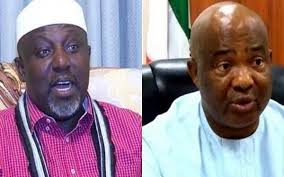
Power Without Influence: The Imo Paradox from Okorocha to Uzodinma
Uwadiegwu Ahumaraeze
When the All Progressives Congress (APC) emerged in 2013 as Nigeria’s new political powerhouse, expectations were high across the country. Those expectations were even greater in Imo State, which proudly stood as the only APC-controlled state in the South-East when the party won the historic 2015 Nigerian presidential election that brought Muhammadu Buhari to power.
At the center of that optimism was Rochas Okorocha, then governor of Imo State and the lone APC governor in the region. By political calculation, Okorocha was widely regarded as the de facto leader of the party in the South-East. His perceived closeness to the Presidency, his frequent presence in the Presidential Villa, and even his fluency in Hausa; often interpreted as a strategic political bridge with the North, fueled expectations that Imo State would enjoy privileged access to federal power.
Those expectations quickly found expression when respected academic and former vice-chancellor Prof. Anthony Gozie Anwukah was nominated for ministerial appointment. His screening before the Senate was widely regarded as impressive, and many Imo stakeholders believed the state was finally on the verge of securing a strategic federal portfolio.
However, the outcome was far from what many anticipated. Instead of being entrusted with a substantive ministerial role, Anwukah was assigned as a Minister of State in the education sector, serving under a retired military officer. Political analysts and commentators at the time described the arrangement as an awkward inversion of expertise, one that symbolized the limits of Imo’s influence despite its supposed proximity to power.
What followed reinforced the perception of a troubling pattern. Subsequent ministerial nominees from Imo under the Buhari administration; including Emeka Nwajiuba and later Goodluck Opiah, were also appointed as junior ministers. For many observers, the recurring outcome suggested that Imo’s political leadership, despite loud claims of influence, struggled to translate party loyalty into strategic federal leverage.
Ironically, this occurred at a time when Okorocha himself rose to national prominence within the ruling party, serving as chairman of the Progressive Governors’ Forum. Yet even with such an influential position within the APC hierarchy, Imo State could not secure a senior ministerial portfolio or attract a truly weighty federal appointment.
Years later, the baton of leadership passed to Hope Uzodinma, whose emergence as governor once again rekindled hopes that Imo would finally command stronger federal relevance. Uzodinma’s own political standing; combined with his role as chairman of the Progressive Governors’ Forum during the administration of Bola Ahmed Tinubu, and his operating from Aso Villa, Abuja, raised expectations that the longstanding imbalance would finally be corrected.
The nomination of Doris Uzoka-Anite appeared to signal such a turning point. Many stakeholders in the state viewed her appointment as an opportunity for Imo to finally secure a strategic voice within the federal economic architecture. Her early performance reportedly brought renewed confidence within government circles, with ministries, departments, and contractors expressing optimism about improvements in financial coordination.
Yet the promise of stability soon gave way to uncertainty. Within a relatively short period, Uzoka-Anite was moved across multiple ministries, eventually landing once again in a junior ministerial role. For political watchers in Imo, the frequent reshuffling revived uncomfortable questions about whether the state’s leadership truly commands the level of trust and influence often claimed within the corridors of power.
Critics argue that the pattern reveals a deeper contradiction in Imo’s political narrative. While successive governors project themselves as powerful allies of the Presidency, the tangible evidence, particularly in terms of federal appointments, tells a different story. In Nigeria’s centralized political system, influence is often measured by the caliber of appointments and opportunities a leader can secure for his state.
Even more puzzling is the contrast with other South-East states that historically delivered fewer electoral votes to the APC but appear to enjoy comparable or even greater federal recognition. For many observers, this contradiction undermines the claim that Imo occupies a privileged position within the ruling party’s national structure.
From the Okorocha years to the Uzodinma administration, the story seems to follow a familiar script: confident assertions of closeness to the Presidency, high expectations among citizens, and ultimately, modest federal outcomes.
For a state that once stood alone as the APC’s political foothold in the South-East, the expectation was that loyalty would translate into influence. Instead, more than a decade later, many Imo citizens are left asking whether the state’s leaders have mistaken proximity for power.
In politics, access is valuable, but results are what truly define leadership. And on that score, the question confronting Imo’s political elite today is both simple and uncomfortable: after years at the center of the ruling party, why does the state still struggle to secure a seat at the federal high table?
About The Author

You may also like
-
WHY WE MUST RESIST THE ‘OLODO’ UPRISING IN IMO STATE
-
HUMANITY FIRST: THE ONE THING AI CANNOT REPLACE By Rt. Hon. Kennedy Chidozie Ibeh, Lawyer,
-
THE RIGHT OF THE PEOPLE TO VOTE AND BE VOTED FOR IS SACROSANCT — NOBODY CAN DENY OR WITHDRAW IT WITHOUT THE CONSENT OF THE PEOPLE By Bishop C. Johnson
-
International Nursing day: Celebrating our awesome Nurses. By: Bruno Ugochukwu.
-
2026 Workers’ Day : Plights of Serving And Retired Workers.